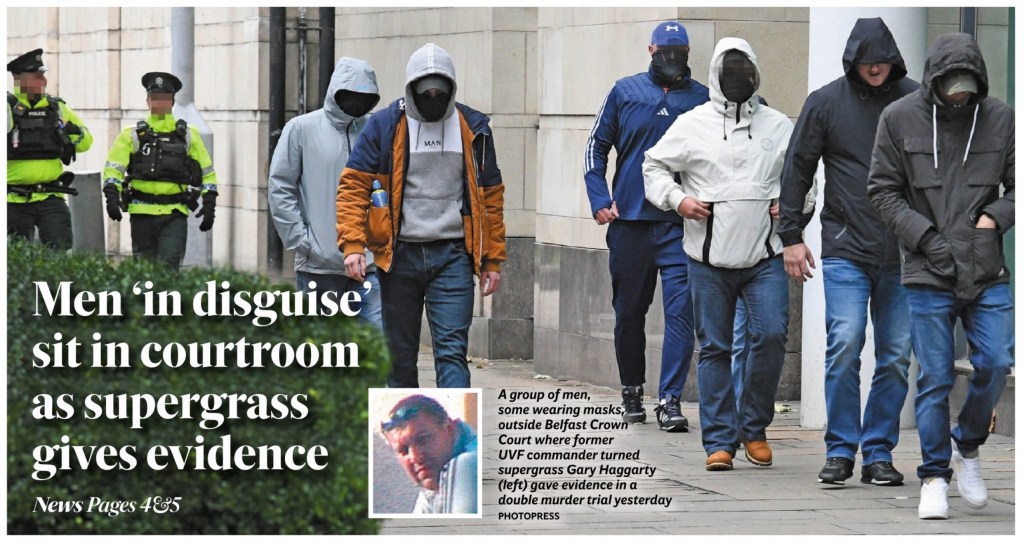
The outrage felt across Northern Ireland this week was palpable. The sight of men with their faces concealed, brazenly strolling into Laganside Court complex was bad enough. However, the revelation that they had the audacity to sit in the public gallery during a UVF murder trial, still sporting their disguises was a sobering moment of truth for the state of the rule of law in this country.
I have been publicly commentating on the problems in our justice system and the corrosion of the rule in Northern Ireland in recent years. For many years within the Police Service of Northern Ireland I observed how an unhealthy culture was spreading throughout the agencies of our justice system, where too many of those in leadership foolishly thought their function was maintaining political tranquility instead of fearlessly upholding the law.
They say a picture paints a thousands words and perhaps it took a tangible and visible affront to justice such as we witnessed this week to prick the public conscience and spur action. The Lady Chief Justice of Northern Ireland has said the presence of masked men was unacceptable and a review has been initiated, but the danger is we look at this outrage through the wrong end of the telescope.
Of course a critical review of the particulars of the case is required and should be straightforward. There will be rudimentary planning and communication lessons for the PSNI, Judiciary and the NI Court Service. But, the danger is that such an operationally focused review misses the real issue – the culture that has evolved that made those men think they could get away with this brazen stunt in the first place.
The weakening of our rule of law and a two tier justice system is a long time in the making and it will require collective will and significant effort to remedy. In Northern Ireland we are not always equal under the law, having friends in high places, being linked to so called paramilitaries or having certain political connections makes a difference, when it should make no difference at all.
The Covid pandemic brought this into sharp relief. The vast majority obeyed the rules at a huge personal and emotional cost. People died alone. Families said goodbye to their loved ones who were in ICU via a computer screen. Others stood in the cold, trying to communicate with their nearest and dearest through the window of a care home.
And some ordinary citizens broke the laws and paid a price. I know of one family who were visited by the police when their son had a birthday party in the back garden and received a total of £6000 in fines. In the rest of the UK, the most powerful in our land faced consequences for their actions, the serving and former Prime Minister’s both received Covid fines because in a democracy we are under equal to the law.
Or at least we are supposed to be, for here in Northern Ireland blind eyes are turned. Thousands of republicans lined the street for Bobby Storey’s funeral on the 30.06.2020 in brazen display of impunity. Not a single prosecution followed, because senior police officers were seemingly unwilling to warn Sinn Fein in writing that what they were planning was illegal.
On the 05.02.2021, 41 people lined up on the Ormeau Road to commemorate the terrible atrocity at the Sean Graham’s bookmaker in 1992. Not a single Covid ticket was issued to anyone. When a man was arrested well after the memorial had finished for disorderly behaviour, a senior member of the Policing Board astonishingly called for his immediate release from custody when he was still in the back of a police car under arrest. The man was duly released, without ever seeing the inside of the custody suite.
Of course, we were to see in August of this year just how far the rule of law was compromised in the follow up to that incident; when Mr Justice Scoffield found that the decision to suspend a law abiding police officer was made to placate political demands and as such was entirely unlawful.
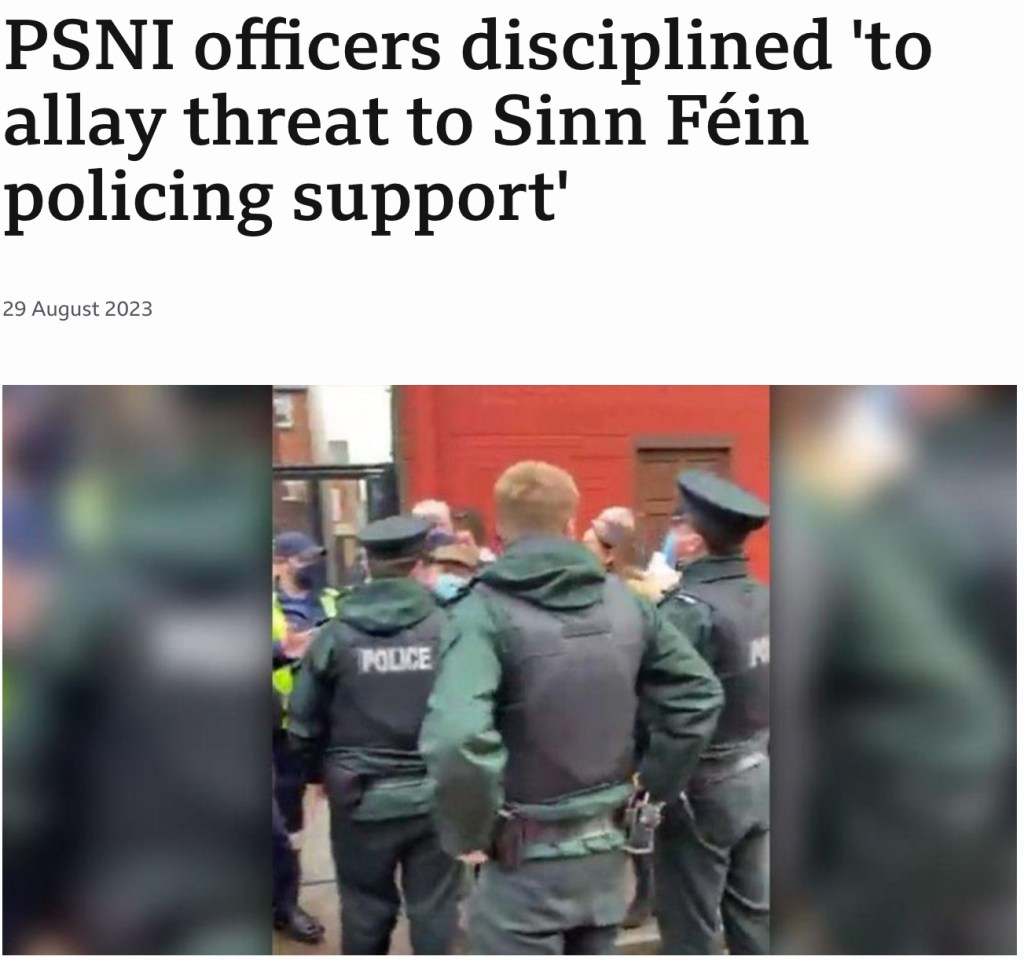
The public were told that he was suspended due to something that was seen in the Body Worn Video, but the private records showed he was suspended to avert political consequences. I’ve spent hours analysing the full video, the officers conduct was flawless. If the published court judgement made grim reading for the Chief Constable, I can assure you that the full disclosure which I have seen is far, far worse.
This fundamental breach of the operational independence of policing from political influence was received by many in the media, politics and high society with a shrug of the shoulder. Some prominent commentator’s barely referenced it in analysing the Chief and Deputy Chief Constable’s demise. It is distinctly inconvenient for some to acknowledge that it happened under their watch and that they missed the red flags.
The duality in our justice system includes the treatment of police officers. The law abiding junior officer who arrested a man after the Sean Graham memorial was unlawfully suspended and publicly humiliated within 24 hours. However more than 50 days after the damming court judgement, the Police Ombudsman has yet to even open an investigation into the senior officers who were found to have acted unlawfully.
This sense of unfairness this causes in the rank and file is one of the leading causes of the morale crisis in the PSNI, evidenced by consistent surveys and the testimony of the Chair of the Police Federation.
Our wider society here is awash with symbols, slogans and songs that glorify terrorism and sectarianism. Chants of Oh Ah Up RA and obscene posters featuring loyalist and republican gunmen go unchallenged and are de facto legalised. All our public bodies, have a statutory duty to promote good relations, but generally inaction is the unwritten policy. In my own village, I had to climb a ladder to remove a grotesque poster myself, the whole community wanted it taken down but no – one in authority would do so.
Inactions have consequences too and all of this normalises paramilitarism and weakens our rule of law.
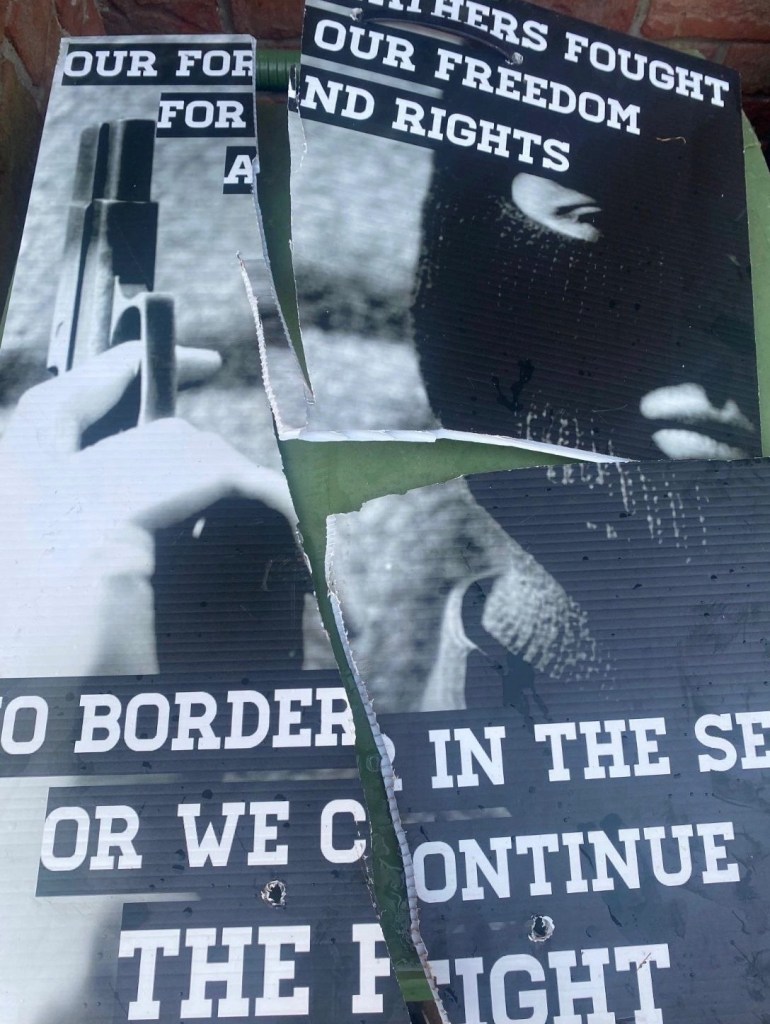
A two tier justice system also gnaws away at the sense of fairness in our society and undermines the legitimacy of criminal justice system. No mercy is shown to the motorist who strays over the speed limit or exceeds a one hour parking limit. It’s feels safer in Northern Ireland to glorify terrorism, than to forget to top up the parking meter.
We all know someone who died with Covid and we all know someone for whom abiding by the Covid laws meant real hardship and sacrifice. Impunity for those with friends in high places doesn’t just corrode the rule of law, it is a slap in the face for the rest of us.
So how, 25 years after the Belfast Agreement did we find ourselves in this hollowed out, two tier justice system. The Agreement itself of course required great sacrifices from the law abiding majority. Terrorist prisoners were released, some having served a fraction of their sentence. The proud and galant Royal Ulster Constabulary GC was renamed and the leaders of terrorism were hailed as peacemakers, essentially for stopping the killings they should never have started.
But whatever one’s views on those aspects of the Agreement, these sacrifices were not necessarily fatal to the rule of law. Mandated by a referendum and underpinned by law; such sacrifices should have been followed by a clear reassertion of democratic principles, instead political expediency was preferred.
The Secretary of State for Northern Ireland, Chris Heaton-Harris said this week that he was shocked at the masked men in court debacle. However, substantial culpability for the origins of our current problems lie squarely at the governments feet.
The concept of an acceptable level of violence by loyalist and republican terrorists during the peace process was a classic triumph of political expediency over the rule of law.
A working class Catholic lad could be shot in the knees by republican terrorists and that was not a breach of the ceasefire. Likewise if loyalists beat the daylights out of a working class protestant boy with baseball bats. The euphemism internal housekeeping had virtual official status. So long as the paramilitary’s didn’t cross sectarian lines or attack the agents of the state, their political wings could carry on regardless. Not all kneecaps were equal.
The notorious On The Run letters further poisoned our legal system. An idea concocted by Sinn Fein and readily accepted by Tony Blair as a confidence building measure – the confidence of terrorists that is as the scheme was kept secret. When the NIO asked the PSNI to be complicit in the scheme, they agreed, including maintaining its secrecy.
The letters were a spectacularly bad idea, devoid of legal standing or proper transparency and accountability; but authorised by those in officialdom who saw themselves as agents of the peace process, instead of servants of the law. There was disquiet in some quarters, but orders were to be followed.
The first that victims of terrorism or the rest of us heard about this shadowy scheme was in the media when John Downey, the suspect for the murderous 1982 Hyde Park bomb avoided trial because he was in receipt of one of these letters. A get out of jail card, astonishingly written by the police at the request of the government.
Our highly capable and committed police service is at times neutered from being operationally decisive, by leaders fearful of upsetting certain politicians. Too often, police officers were injured in riots when tactics such as baton rounds should have been authorised or when protective equipment should have been worn.
Politics should never compromise health and safety and ethical police engagement with politicians is about explaining operational decisions, not seeking permission to make them. The problem with culture, is people can start making wrong decisions with myopic conviction that they are doing the right thing.
Sometimes investigations after riots were insufficiently rigorously and swift and visible justice was usurped by back room dealing. Good policing involves community dialogue, but never at the expense of upholding the law. The law can be upheld without causing mayhem, it just requires skill and will.
The growth of Sinn Fein electorally has outpaced its maturity as a normal party. Instead of role modelling the sanctity of the rule of law, those in high Public Office have eulogised and honoured mass murderers. This is often in complete contradiction of the codes of conduct that apply to their elected offices. But action is never taken by standards Commissioners and dissident republicans feed off the perpetuated legitimacy of physical force republicanism.
Sinn Fein, as of yet has not attended a single PSNI passing out ceremony, spurning another opportunity to signal the nobility of the vocation of upholding the rule of law to their sizeable electorate. Sinn Féin’s historic decision to support policing is better described as agreeing to hold it to account and sit on the Policing Board.
The sanitising of terrorism has leaked like a poison into the well that is our whole justice system. A seasoned dissident terrorist convicted of attempting to murder a police officer was recently sentenced to just four years in prison. In Great Britain or the Republic of Ireland he would have received 3-4 times longer.
Whilst awaiting sentencing after conviction, the same terrorist was inexplicably released on bail and during that period he was arrested and charged with the attempted murder of DCI John Caldwell. It’s mind boggling stuff and aside from failing to protect the public, the current judicial weakness sends all the wrong signals to the police, the public and the terrorists.
The reality is that The Troubles are over. Dissidents pose a much reduced, but still occasionally lethal threat and so called paramilitaries mainly engage in intimidation and pocket lining crime. But they do not have widespread support, they cannot pull thousands onto the streets to cause mayhem and they only exercise the power that we collectively cede to them.
Whilst maintaining constant vigilance on the severe threat, we ought to be more assertive and proactive with those who operate under the banner of paramilitaries. The agencies of the state need to start dealing with those who sing the songs, chant the hate and put up grotesque memorials. The consequences for being convicted of serious terrorist crimes should be long sentencing such as we see elsewhere.
I know the rank and file of the PSNI operate without fear or favour and they have the skill and will do to their job. But they need the support from within and without policing to uphold the law; and that means support in good times and bad. So long as they are honest and hardworking; they should not fear being thrown under the bus by a weak leader at the request of a demanding politician.
So when you try to understand how 25 years after the Good Friday Agreement, a group of men dressed for a bank robbery can walk past the police and sit in the public gallery of a court of law during a UVF murder trial, make sure to look through the right end of the telescope.
The word crisis is overused, but without doubt it has been appropriate to describe policing and the state of the justice system in recent months. But crisis also presents opportunity, we need leaders who will grasp it – policing leaders, political leaders and community leaders.
Leadership isn’t the title you hold, but what you do with it.
Jon Burrows
Retired PSNI
Twitter (X) @JonBurrowsNI
In Part Two, I’ll be discussing what steps could be taken to strengthen the rule of law in Northern Ireland.

 Burrows Blog