Introduction.
There is no place for bigotry in any police service. The public must be able to trust that officers will conduct their duties impartially and everyone must be treated with dignity in their workplace.
Sectarian officers should be sacked, but allegations without evidence require examination.
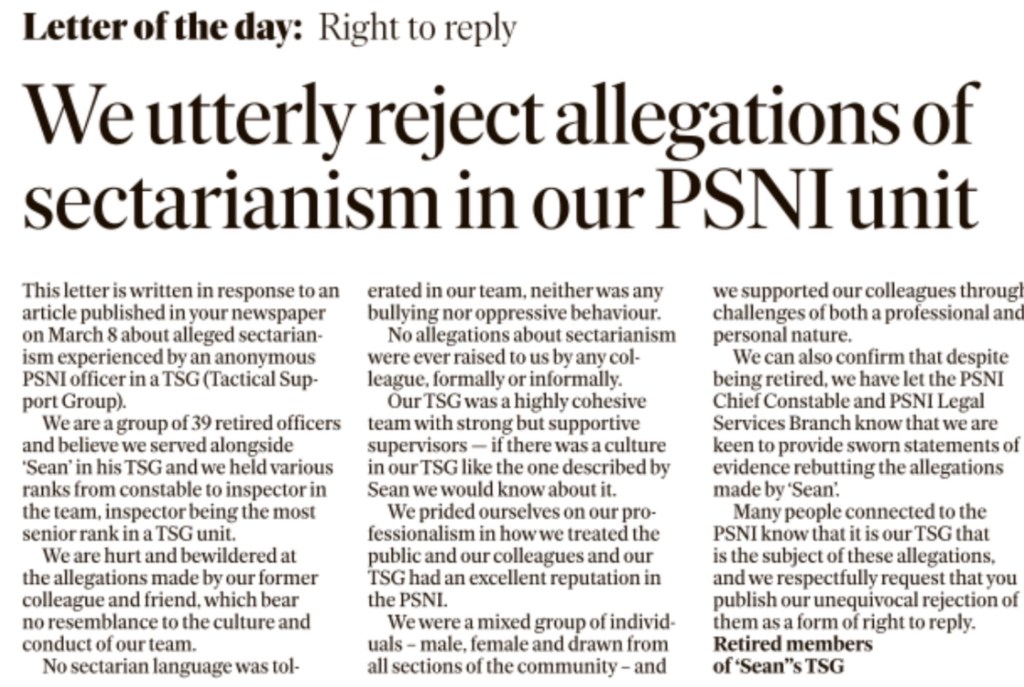
The article earlier this month in the Belfast Telegragh about the experiences of Sean a retired PSNI officer, in one of the PSNI’s Tactical Support Group’s (TSG) shocked me. (https://www.belfasttelegraph.co.uk/opinion/columnists/sam-mcbride/one-of-psnis-first-catholic-recruits-quits-in-dismay-i-regret-joining-i-just-feel-scarred-by-it/a1708759200.html)
The conduct described was not one I recognised, and I was flabbergasted when I became aware of the particular TSG that the allegations related to, they were the finest TSG I’ve encountered in my career.
Hardwired into the DNA of this particular TSG are values that make it an exemplar of professionalism. This TSG have always been operationally excellent, community sensitive and extremely supportive of its members. This is not and was not a body of men and women who engage in or tolerate bigotry or bullying.
I know who Sean is because there are unique aspects to his testimony, but I will not disclose his identity. However, I have major concerns around the veracity of the account he provided about his experiences in the PSNI and the TSG.
Allegations of sectarianism carried in a major newspaper have very serious consequences (which is why it is manifestly in the public interest that if there are serious question marks over their veracity, the public record must reflect them).
The consequences of high profile sectarianism allegations include *
- Damage public confidence in PSNI.
- Damage confidence of vulnerable victims in particular to report crimes such as abuse.
- Damage police morale & cohesion.
- Cause hurt to former colleagues.
- Impede Catholic recruitment to the PSNI.
- Fuel dissident republican narratives used to radicalise young people.
These consequences are so serious that I need to set out some facts and put under the microscope his high profile allegations of unfairness and sectarianism.
1. Harrangued by the Police Federation for money he doesn’t have.
Sean stated he is “being pursued for thousands of pounds which I don’t have” by the Police Federation, for ‘medical bills’ linked to his retirement process. Sean said he was made to “feel like dirt” by the Federation. This portrayal by Sean invokes a sense of him being unfairly treated by the Federation over money for medical bills he can’t pay. It sets the scene for his sectarianism allegations. His statement is very problematic.
Sean was given a very substantial six figure lump sum as part of his pension and receives a monthly pension well above the average wage here. There are reliable ways of calculating an officer’s medical pension and I’m sure of my facts.
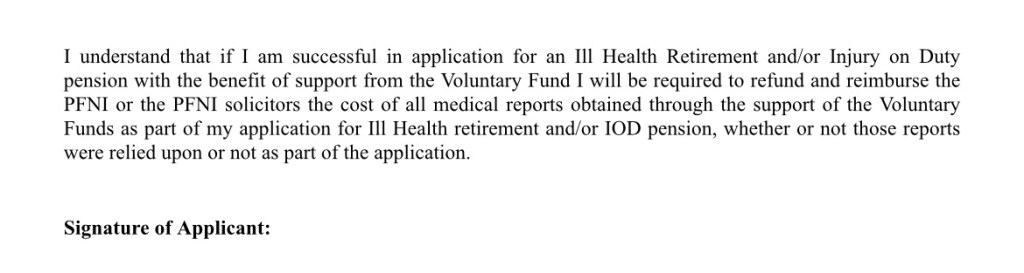
The money Sean has been asked to repay was provided by a Federation’s scheme that operates in the same way for everyone. An officer applying for a medical retirement can seek assistance to pay for optional private medical assessments to bolster it. These reports are optional and not mandatory for the process.
Each officer signs a crystal clear form promising to pay this money back if their medical retirement application is successful and only after they receive their pension lump sum. All other costs, including substantial legal fees, are paid by the Federation, these legal costs will amount to thousands of pounds & Sean is almost certain to have benefited from this support.
I attach a copy of the very clear form that Sean will have signed promising to pay back money for the medical reports.
The fund that Sean is refusing to pay money back to is used for vital welfare work, including supporting the widows of officers who died in service and their children, and the money comes from serving officers monthly subscriptions. Armed with the full facts, the public will be able to see there is nothing unfair or discriminatory here.
Not paying back money you effectively borrowed from colleagues does not make you a victim, it raises questions over your integrity.
I do cross community food bank deliveries on a voluntary basis – if Sean wants to see what it looks like having no money he can come and join me for a shift.
So having dealt with the allegations of being pursued unfairly for money he doesn’t have – let’s turn to the sectarianism allegations.
2. A TSG unit of “30 men and 3 Catholics” says Sean. An account of pure fiction.
Sean states that his TSG was made up of “30 men” with three Catholics and due to being outnumbered he couldn’t speak up about sectarianism. Sean states in the news article that he never reported any of the blatant sectarianism he alleges he experienced in his TSG.
Facts don’t lie and here are the facts.
There were multiple females in this team and numerous members of Sean’s team were of a Catholic background. I must stress, that colleagues’ religions did not matter to any of them, they were colleagues and friends.
There were many Catholic sergeants in this team over the time-period. Every TSG is commanded by one Inspector, and several of Sean’s Inspector’s in the very long time he was in this allegedly sectarian team were Catholic.
Numerous critics have claimed recently that the PSNI is dominated by a white, male and Protestant culture and Sean’s testimony reinforces this picture, except the facts don’t fit the narrative.
Why has he not referenced the highly valued women in the team?
Why airbrush them out? Hardly the actions of a warrior for equality and diversity.
Why not mention the Catholic supervisors who were outstandingly strong, approachable and supportive leaders?
These men and women were amongst the best leaders policing in Northern Ireland has ever seen. I will swear on oath to that. They stand ready to testify.
Why is Sean reinforcing the critics narrative of a male, white, Protestant culture in the PSNI by citing demographics of his former team that are misleading, but which validate the false narrative that is often pedalled ?
Was it because it helps provide some logical explanation to the reader why he stayed in a team for 15 years without ever mentioning to anyone the sectarian abuse he experiencing ?
Was it to mask what TSG he was in so his former colleagues wouldn’t twig and call out his allegations or offer to provide rebuttal evidence ?
The more we dig into Sean’s claims the more problematic they all are.
3. Sean has told two diametrically opposite stories.
Sean stated very clearly to the Belfast Telegraph in the article that he had not reported the sectarian abuse he was subjected to in the TSG.
This is both true and puzzling. It’s true Sean never reported any sectarian abuse in the TSG.
It’s puzzling because Sean has sent people allegations which appears contradictory.
Below is an extract from an email I have verified, it was sent by Sean in which he states that “throughout his career” “he faced repeated incidents of sectarian hostility” which “included” 👇

What does Sean mean by “instances where I felt complaints about sectarian behaviour were ignored, dismissed or resulted in further victimisation”.
Did he make complaints or not ? Why the apparent contradiction?
Why not mention the victimisation to the Belfast Telegraph.
What form did it take?
The more Sean’s allegations are examined the more they fall apart and the trust me I could write more.
3. Sean stayed 15 years in a team that bullied him.
Sean was in this TSG for 15 years without raising any issue about sectarianism. This team is renowned for its long retention of officers, due to its morale and supportive culture.
The turnover in this team has always been very low, not like many other teams who for various reasons have a high churn of officers and supervisors. It is not a team, like for example a response policing team, that has other team members ‘backfilling gaps’. So the sectarian remarks alleged can’t be put down to strangers.
This very cohesive unit has a strong culture, but a really good one. Sean was loved and socialised with all his colleagues.
Due to the structure and role of TSG’s there is generally a sergeant on patrol with constables, the level of supervision is the closest in the PSNI.
Sean was close enough to his TSG supervisors and colleague’s to invite them to family events (and they all attended other family occasions in support of him). I will not expand this point further out of respect for his privacy, but the level of support, flexibility and accommodation Sean was given was immense.
The integration and cohesiveness of the particular team that Sean has maligned is unparalleled in my experience. If anyone spoke to him in that way they ought to be sacked, but former colleagues are mystified and hurt by his allegations.
The Ash Wednesday allegation.
Sean states that he wore Ash Wednesday on his forehead and as a result was subjected to sectarian abuse.
Sean can presumably provide the date in which the incident happened in the 15 years that he was in the TSG. The electronic duty roster system will be able to identify all the Ash Wednesday’s he worked.
I understand there isn’t anyone who can recall him wearing ash on his forehead ever.
Note that officers in the TSG, including Sean, travelled to work together in groups, then attend a briefing room together, then patrol and train together.
Sean needs to think very carefully about this allegation and what year it occurred.
Conclusion
Sean has made serious allegations of sectarianism against colleagues who supported him through much adversity. These are a fine body of men and women, who do not deserve what has happened. The wider consequences of sectarian allegations are very serious, this is a matter of high public interest.
Sean has not as far as I know followed up his claims in the Belfast Telegraph with a complaint to the PSNI for investigation or named the people in his TSG who allegedly subjected him to sectarian abuse.
As it stands there is therefore no investigation & no mechanism for proving or disproving his claims, but there are serious concerns about their veracity.
In contrast to his anonymous allegations, dozens of his former colleagues have committed to providing sworn evidence and have requested a thorough investigation. The PSNI leadership needs to support Sean’s retired and serving colleagues – they are hurt & bewildered. They need to hear support, directly and publicly.
I suspect might Sean regret making the sectarian allegations that have hurt so many good people and complaining about paying back money which he expressly had undertaken to repay. I’ve no doubt he is in a difficult place.
Sean’s allegations are serious, but made without it appears a scintilla of evidence, indeed there are apparent inconsistencies with his account.
The retired officers who have rebutted his account are consistent, credible and cross community. The members of this group cover the entire time span Sean was in the TSG in question. They wish to swear on oath their team was the antithesis of a sectarian one.
The truth must be established.
End.

 Burrows Blog